
Counterfeit Brick
how sorting LEGO made me think about discernment

Recently I found myself sifting through a box of buy/sell/trade building bricks and thinking about Christian discernment. When you have kids who build amazing things from LEGO, you don’t pass up boxes of used bricks for a good price. However, I quickly discovered this particular box didn’t pass the purist test. Meaning, most of the bricks weren’t actually LEGOs.
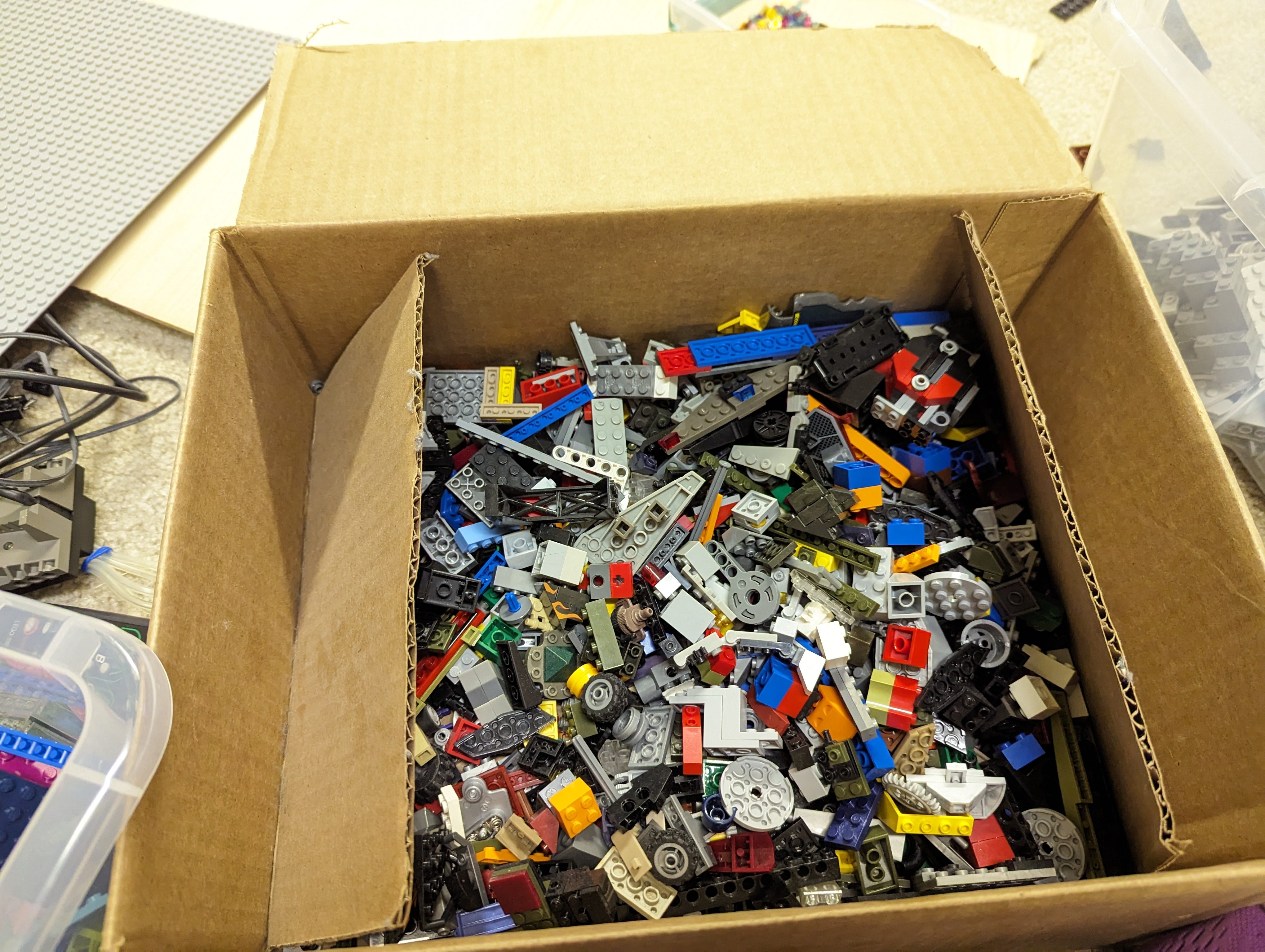
I didn’t know the ratio of LEGOs vs. non-LEGOs when I started sorting. Some brands get so close to LEGO that a quick glance over a box won’t tell you what you need to know. It takes sorting one by one to separate the authentic from the imposters. As I started working, I began to notice certain tells: some bricks aren’t a close imitation; I could tell by looking that it wasn’t the same plastic and those immediately went into the discard pile. Some got the design a little closer, but the coloring wasn’t right; a quick logo check confirmed its placement in the discards. Some got really close but still, when touched, the plastic wasn’t quite right and the logo sent those, also, to the discard pile.
But why even go to all that trouble, Malinda? Truly, it would be easier not to care right? For awhile, when the kids were first getting into small building blocks, I didn’t. Long ago, our daughter’s first set was given as a gift. The Barbie Mega Bloks set was what made us realize she would probably like LEGO. My husband was already a purist in his own right, and I quickly came along. To minimize the amount of bricks we had to contain, we decided: no more imposters. But let’s be real, LEGO is expensive, so to curb the expense, buying used can be helpful. Sometimes you hit the jackpot (thanks again Elaine!) and sometimes…well, sometimes…you get rid of more than you keep.
And this is how I ended up thinking about discernment while sorting LEGOs.
Tim Challies in his book The Discipline of Spiritual Discernment, uses a money analogy to aid his points. As I sat sorting bricks, a theme from his book kept coming to mind: you have to know what’s real so you can know what’s fake. With money, people who handle a lot of it can spot (or feel) something off because of the quantity of real money they spend time with. As a former bank teller, I can vouch for this. The same is true for LEGOs — the more time you spend touching real bricks, the easier it is to discern something fake. And if I have questions, I go to my three resident LEGO experts and they can usually tell me right away to keep or discard.
The same is also true for scripture. The more time Christians spend knowing what’s true, the better we’ll be at determining what’s fake. Like bricks, some counterfeits are pretty obvious — but only if you know counterfeits exist. If we’d never given our kids real LEGO bricks, they wouldn’t have been exposed to something better. As a Christian, it’s important to believe what scripture says: counterfeits exist. Some teachings are poor replicas and easily discarded, but that’s not always true…the better the counterfeit, the closer it looks to the real thing. Knowing the real thing — in this case what God Himself says is true — is what helps discern between the two.
Challies defines discernment this way: “the skill of understanding and applying God’s Word with the purpose of separating truth from error and right from wrong.”1 * Challies is right to say discernment is a learned skill. We’re not inherently born knowing what’s what. The more we practice the skill of discernment, the better we’ll be. And how do we practice?
Over and over, the Bible tells believers to test everything. We are to compare what we’re told and what we observe with what’s in scripture. Challies puts it this way: “A survey of passages of Scripture relevant to the subject of discernment, words dealing with testing, judging, approving, and the like, will reveal nothing that would allow us to believe that the Holy Spirit will provide some type of subjective sense of discernment apart from the Bible. Instead we see that discernment points us continually to the Scriptures, to the objective source of truth meant to guide us in all matters of life and faith. Any method that points anywhere but Scripture implicitly points away from Scripture. It must be rejected.”2
As a Christian, knowing what’s true means knowing what God says. The author of Psalm 119 does this well, and I highly recommend reading and praying the psalm in its entirety. The psalmist starts out by celebrating those who walk in the law of the Lord and then reminds the reader over and over to return to God’s Word — His precepts, His statutes, His rules, His testimonies, His promise, His law, His commandments. Throughout the text, the psalmist speaks of discernment as precious. From beginning to end, the psalmist takes delight in repeatedly returning to God’s Word and the treasure of truth found there. Here are just a few examples:
Blessed are those whose way is blameless, who walk in the law of the LORD! v. 1
Those who fear you shall see me and rejoice, because I have hoped in your word. v. 74
If your law had not been my delight, I would have perished in my affliction. v. 92
Your testimonies are my heritage forever, for they are the joy of my heart. v. 111
Therefore I love your commandments above gold, above fine gold. v. 127
Therefore I consider all your precepts to be right; I hate every false way. v. 128
The unfolding of your words gives light; it imparts understanding to the simple. v. 130
The sum of your word is truth, and every one of your righteous rules endures forever. v. 160
The list of verses encouraging, even admonishing, a commitment to scripture from Psalm 119 alone could be quite lengthy and is worth in-depth study…as is the whole of scripture because, just like learning how to determine counterfeit money, or real LEGO bricks from imposters, Christian discernment takes time and practice. But it’s worth it! In the end, I want to be found in the company of the psalmist of 119, committed to and celebrating the righteous Word of God as the treasure it is, and I hope you’ll join me.
Let’s start here:
What are you currently studying in scripture?
Footnotes
The Discipline of Spiritual Discernment by Tim Challies, page 61
The Discipline of Spiritual Discernment by Tim Challies, page 69
Resources
* The section of Challies’ book where he defines discernment and expands on each section is available for free on his website: https://www.challies.com/articles/defining-discernment/
The Discipline of Spiritual Discernment by Tim Challies
Counterfeit Kingdom by Holly Pivec and Douglas Geivett
And finally, if you’re curious what kind of builds we get at our house, here’s a photo of my three resident Brick Masters and a recent creation…they built it on their own; no building manual. They amaze me in so many ways!

Um, first of all, your kiddos creation is absolutely amazing!
Then, to answer your question, I'm currently studying Romans 8.
This is a fantastic analogy and a fantastic post, Malinda!
I often feel like spiritual direction sessions, where we're trying to listen to God together, are easier when the person has been steeped in Scripture--even if that Scripture has been used against them in a previous time. Even if it's been misrepresented and misinterpreted, the basic awareness of what it "says" on any level helps when trying to listen to the Holy Spirit--and working through the falsehood that was absorbed before.